
📋 Table of Contents
- The Problem: Most Indian Ecommerce Sites Are Invisible on Google
- Reason 1: Higher Visibility = More Customers Finding You
- Reason 2: SEO Brings Buyers — Not Just Browsers
- Reason 3: More Sales & Conversions — SEO Visitors Convert Better
- Reason 4: Better User Experience = Lower Bounce, Higher Trust
- Reason 5: Long-Term Growth — SEO Compounds While Ads Stop
- What Makes an Ecommerce Website SEO-Friendly?
- SEO vs Paid Ads for Ecommerce — The Real Comparison
- How TechMR Builds SEO-Friendly Ecommerce Websites in Mumbai
- Frequently Asked Questions
- Conclusion
India's ecommerce market crossed ₹5 lakh crore in 2025 — and it's still growing at over 20% annually. But here's what the headline number doesn't tell you: the vast majority of that revenue is captured by businesses whose websites are built for Google, not just for customers.
The typical Mumbai ecommerce business owner invests heavily in product sourcing, warehouse management, social media content, and Instagram ads — but treats the website itself as a secondary concern. The result? A beautiful online store that nobody organically finds. A business entirely dependent on paid advertising with zero SEO foundation — paying for every single visit, every single day, indefinitely.
This guide explains why this approach is a competitive disadvantage in 2026, what an SEO-friendly ecommerce website actually means in practice, and how TechMR's ecommerce website development team builds online stores that rank, attract qualified buyers, and grow your business 24 hours a day — without depending entirely on paid ad spend.
The Problem: Most Indian Ecommerce Sites Are Invisible on Google
TechMR audits dozens of ecommerce websites every month — from WooCommerce stores in Andheri East to Shopify boutiques in Bandra. The pattern we see repeatedly is alarming: over 85% of Indian ecommerce websites have critical SEO issues that are actively suppressing their Google rankings.
Common problems include: duplicate product descriptions copied from the supplier's catalogue, no meta titles or meta descriptions on product pages, missing schema markup (so Google can't show star ratings and prices in search results), poor mobile performance causing Core Web Vitals failures, no category page content, zero internal linking strategy, and product URLs that are meaningless strings of numbers instead of keyword-rich descriptive paths.
Each of these issues represents missed organic traffic — customers actively searching for exactly what you sell, who find your competitors instead of you. And in a market as competitive as Mumbai's ecommerce landscape, that is a cost your business cannot afford to ignore.
Get a Free Ecommerce SEO Audit for Your Online Store
TechMR will analyse your ecommerce website's SEO health and show you exactly what's costing you organic traffic and sales — free, within 48 hours.
Reason 1: Higher Visibility = More Customers Finding You
Google is Where Your Customers Start — Be There or Be Invisible
93% of online experiences begin with a search engine. When a customer in Mumbai searches "buy leather wallet online" or "women's ethnic wear Mumbai delivery," Google decides whose products they see. If your ecommerce website isn't optimised to rank for these searches, you simply don't exist for that customer — no matter how good your products are.
SEO-friendly ecommerce websites are structurally built to capture this search intent. Every product page, every category page, every blog post is a potential entry point for a buyer who is actively looking for what you sell. A well-optimised ecommerce store with 500 products effectively has 500+ separate ranking opportunities on Google — 500 doors for customers to walk through.
For Mumbai businesses competing in categories like fashion, electronics, home decor, or FMCG — where both national giants (Myntra, Flipkart, Amazon) and hundreds of local brands are vying for the same keywords — strong on-page SEO is the only sustainable path to visibility without an unlimited advertising budget.
Reason 2: SEO Brings Buyers — Not Just Browsers
Organic Search Traffic is High-Intent — These Visitors Want to Buy
Not all website traffic is equal. A visitor who lands on your ecommerce site from a Google search for "buy running shoes size 10 Mumbai" is fundamentally different from someone who saw your Instagram ad while scrolling. The Google searcher has purchase intent — they are actively looking for a product to buy. The social media scroller may have been entertained by your ad but had no intention of shopping before seeing it.
This is why SEO traffic converts at a significantly higher rate than social or display advertising traffic. SEO leads have a 14.6% close rate on average — compared to 1.7% for outbound marketing. For ecommerce businesses in Mumbai where every conversion matters, this difference is enormous.
- Branded keywords — "TechMR ecommerce development" — capture customers already aware of your brand
- Product keywords — "buy handmade leather bag Mumbai" — capture bottom-of-funnel buyers ready to purchase
- Category keywords — "women's ethnic wear online India" — capture mid-funnel shoppers comparing options
- Informational keywords — "best running shoes for flat feet" — capture top-of-funnel buyers starting their research
A well-structured SEO strategy targets all four keyword types — creating a funnel that captures buyers at every stage of their purchase journey and guides them toward your products.
Reason 3: More Sales & Conversions — SEO Visitors Convert Better
SEO-Optimised Product Pages Are Built to Convert, Not Just Rank
Here's what most ecommerce business owners miss: SEO optimisation and conversion optimisation are the same thing. The elements that make a product page rank well on Google — clear headlines, detailed descriptions, fast load times, mobile responsiveness, customer reviews, structured data — are the exact same elements that make customers trust your store and complete a purchase.
An SEO-friendly ecommerce product page includes:
- Rich product titles that include the product name, key attributes, and a brand signal
- Detailed, unique product descriptions that answer buyer questions and include naturally placed keywords
- Product schema markup that shows star ratings, price, and availability directly in Google search results — dramatically improving click-through rates
- Optimised product images with descriptive alt text that also help products rank in Google Image search
- Customer reviews displayed with review schema for Google Rich Snippets
- Fast load times — every 1-second delay in page load reduces conversions by 7% on ecommerce sites
Reason 4: Better User Experience = Lower Bounce, Higher Trust
Google Rewards UX — And So Do Your Customers
Since Google's Page Experience update, user experience metrics — Core Web Vitals, mobile-friendliness, safe browsing, and HTTPS — are direct ranking signals. This means that building an SEO-friendly ecommerce site and building a great user experience are no longer separate goals. They are the same goal.
For Indian ecommerce businesses, where over 70% of shopping traffic comes from mobile devices, this is especially important. A Mumbai customer browsing your online store on a 4G connection won't wait 8 seconds for your product images to load. A confusing navigation structure that makes it hard to find the right category will send them straight to a competitor. A checkout form that's difficult to fill on a phone will cause cart abandonment.
SEO-friendly ecommerce design principles that also dramatically improve user experience:
- Clear category hierarchy — logical navigation that Google can crawl easily and customers can browse intuitively
- Breadcrumb navigation — helps users understand where they are and signals page hierarchy to Google
- Internal linking between related products — increases pages per session and distributes SEO authority across your catalogue
- Mobile-first checkout design — reduces cart abandonment and improves conversion rates on all devices
- Fast-loading compressed images — improves both Core Web Vitals scores and user experience on slow networks
- SSL certificate and trust signals — required by Google (HTTP sites are demoted) and critical for customer trust in payment security
Reason 5: Long-Term Growth — SEO Compounds While Ads Stop
SEO is a Business Asset. Ads are an Ongoing Expense.
This is perhaps the most important reason of all. Paid advertising is a tap — SEO is a reservoir. When you turn off your Meta or Google Ads, traffic stops immediately. When you stop investing in SEO, your rankings don't disappear overnight — they persist, continue to drive traffic, and compound over time as your domain authority grows.
Consider the long-term economics for a Mumbai ecommerce business:
- A ₹30,000/month Google Ads budget drives traffic only while the budget is active. Stop paying — stop getting traffic. Over 3 years: ₹10.8 lakh in ad spend, zero residual value.
- A ₹30,000/month SEO investment over the same 3 years builds domain authority, backlinks, content assets, and rankings that continue generating traffic indefinitely — even if SEO investment reduces. The ₹10.8 lakh creates a permanent competitive asset.
This doesn't mean ecommerce businesses should abandon paid ads — PPC and SEO work best together. But building your entire traffic strategy on paid ads alone, with zero SEO foundation, is an unsustainable business model that leaves you permanently at the mercy of rising CPCs and algorithm changes on ad platforms.
Build an SEO-Friendly Ecommerce Website with TechMR
Every ecommerce website TechMR builds is SEO-optimised from day one — product schema, fast load times, keyword-rich pages, and a content structure built to rank on Google.
What Makes an Ecommerce Website SEO-Friendly?
Not every ecommerce website is built equal from an SEO perspective. Here is TechMR's complete checklist of what separates an SEO-friendly ecommerce website from one that's invisible on Google:
✅ TechMR's SEO-Friendly Ecommerce Website Checklist
- Keyword-rich, descriptive product URLs (e.g. /buy-handmade-leather-wallet-mumbai)
- Unique, detailed product descriptions — no supplier copy-paste
- Optimised meta titles & descriptions on every product & category page
- Product schema markup (price, availability, rating in Google results)
- Category pages with 150–300 words of keyword-rich introductory content
- Core Web Vitals in "Good" range — LCP ≤ 2.5s, INP ≤ 200ms, CLS ≤ 0.1
- All product images compressed to WebP with descriptive alt text
- Breadcrumb navigation with BreadcrumbList schema markup
- XML sitemap submitted to Google Search Console
- Internal linking — related products, cross-sells, category links
- Canonical tags on paginated collection pages to prevent duplicate content
- Mobile-first responsive design — tested on real Android & iOS devices
- SSL certificate + HTTPS enforced across all pages
- Customer reviews with aggregate rating schema markup
- Google Analytics 4 + Search Console connected and tracking conversions
- India-region hosting / CDN for fast Mumbai & national load times
SEO vs Paid Ads for Ecommerce — The Real Comparison
Many Mumbai ecommerce business owners ask: "Why invest in SEO when I can just run Google Shopping ads?" The answer is not that ads are bad — it's that ads without SEO is a permanently expensive strategy. Here is the honest comparison:
| Factor | Ecommerce SEO | Google / Meta Ads |
|---|---|---|
| Traffic when you stop paying | Continues (diminishes slowly) | Stops immediately |
| Cost per visitor over time | Decreases as authority builds | Increases with competition |
| Time to first results | 3–6 months | Immediate (hours) |
| Trust & credibility signal | High — organic = trusted | Lower — marked as "Ad" |
| Conversion rate | Higher (purchase intent) | Lower (interruption model) |
| Scalability without extra spend | Yes — rankings scale freely | No — more traffic = more cost |
| Long-term business asset | Yes — domain authority is permanent | No — value ends with budget |
| Best use case | Long-term sustainable growth | Product launches, seasonal peaks |
💡 TechMR's Recommendation: The most successful Mumbai ecommerce businesses use both — paid ads for immediate traffic and product launches, SEO for sustainable organic growth that reduces long-term customer acquisition cost. Never build your entire strategy on paid traffic alone, and never ignore paid ads while waiting for SEO to kick in. The two channels reinforce each other.
How TechMR Builds SEO-Friendly Ecommerce Websites in Mumbai
At TechMR, every ecommerce website we build is SEO-optimised from the very first line of code — not as an afterthought, not as an add-on, but as a core requirement of every project. Here is our approach:
Architecture-First SEO
Before we design a single page, TechMR's SEO team maps out your site architecture — category hierarchy, URL structure, internal linking blueprint, and keyword targeting plan. Getting the structure right from the start means every product and category page is built to rank for the right keywords — not retrofitted for SEO later.
Performance-Optimised from Launch
Every TechMR ecommerce website launches with Core Web Vitals in the "Good" range — India-region hosting or CDN configured, images converted to WebP, caching enabled, render-blocking scripts eliminated. We never deliver a slow ecommerce website, because a slow website means lost sales and suppressed rankings from day one.
Complete Schema Markup Implementation
TechMR implements Product schema, BreadcrumbList schema, AggregateRating schema, and LocalBusiness schema on every ecommerce website we build. This enables Google Rich Snippets — star ratings, prices, and availability shown directly in search results — which dramatically improves click-through rates for your product pages, even before you've climbed to position #1.
Integrated SEO & Content Strategy
A product catalogue alone is not enough for strong ecommerce SEO in 2026. TechMR develops a content strategy for every ecommerce client — including category page content, buying guides, product comparison pages, and a blog calendar targeting informational keywords that drive top-of-funnel traffic. Our blog writing and content with SEO services keep this content engine running month after month.
Frequently Asked Questions
Why is SEO important for ecommerce websites in India? +
What makes an ecommerce website SEO-friendly? +
How long does ecommerce SEO take to show results? +
Should I choose SEO or Google Ads for my Mumbai ecommerce store? +
Can TechMR make my existing ecommerce website SEO-friendly? +
How much does ecommerce SEO cost in Mumbai? +
Conclusion: In 2026, an Ecommerce Website Without SEO Is a Liability
The Indian ecommerce market has never been more competitive — or more full of opportunity. The businesses that will dominate their categories in the next 3–5 years are the ones making the right foundation decisions today. And the most important foundation decision an ecommerce business can make is building a website that Google can find, understand, rank, and recommend to buyers.
To summarise why every ecommerce business needs an SEO-friendly website in 2026:
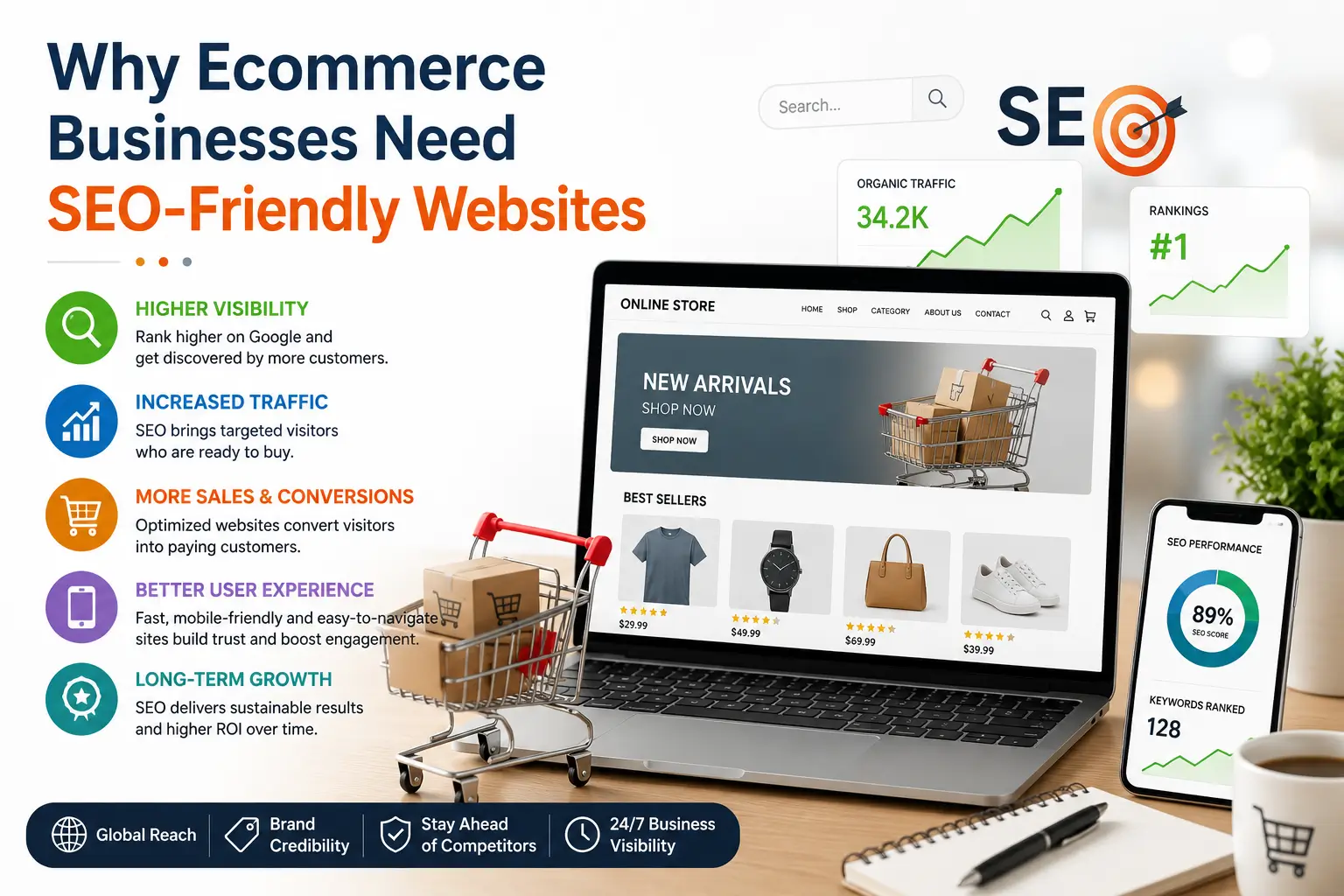
- Higher Visibility — 93% of online experiences start on Google. Be on page 1 or be invisible.
- Increased Traffic — SEO attracts buyers with purchase intent, not passive scrollers.
- More Sales & Conversions — SEO-optimised product pages convert at 14.6% vs 1.7% for outbound channels.
- Better User Experience — UX optimisation and SEO optimisation are the same goal in 2026.
- Long-Term Growth — SEO builds a permanent business asset that compounds over time.
TechMR builds ecommerce websites in Mumbai that are designed to rank from day one — with architecture-first SEO, performance optimisation, complete schema markup, and an integrated content strategy. If your current ecommerce website is dependent entirely on paid traffic with no SEO foundation, every day you wait is a day your competitors are getting ahead of you in organic search.
Don't let your products stay invisible. Let TechMR build you an ecommerce website that Google loves — and customers find.
Ready to Build an SEO-Friendly Ecommerce Website?
Get a free consultation with TechMR's ecommerce development and SEO team. We'll audit your current site (or plan your new one) and give you a clear roadmap to organic growth.